About microstructure
A branch of quantitative finance that studies how the behavior of market participants, volatility, orderflow intensity, liquidity, spreads, trading volumes and other market data parameters affect prices
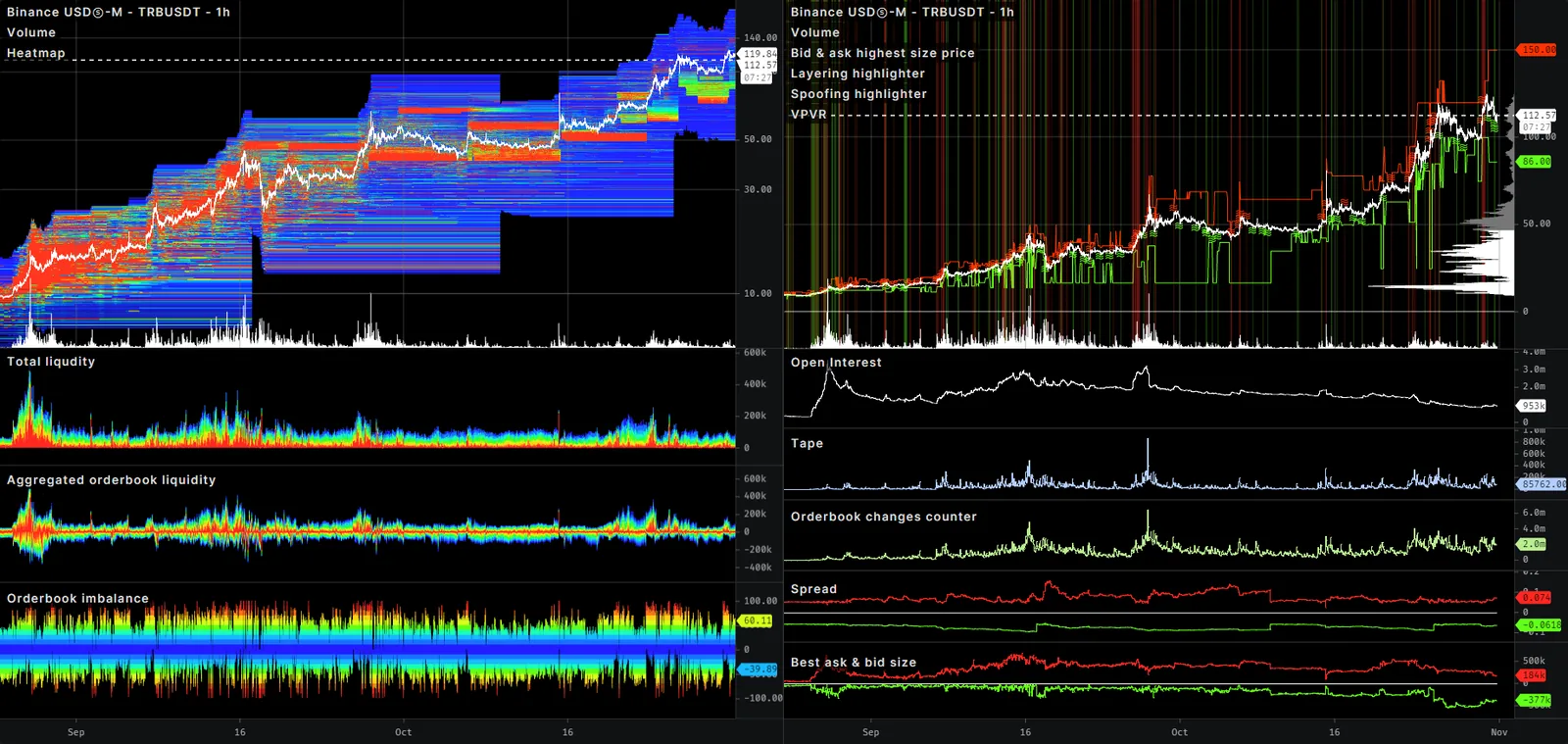
Tools for visualizing the market at the micro level
Market microstructure is a field of finance that studies how prices form in financial markets and how market participants interact at the micro level. It analyzes how participants decide to buy and sell financial assets, including stocks, bonds, derivatives, cryptocurrency and others.
This is a fairly young branch of quantitative finance. It began to develop actively as trading went digital and electronic trading venues appeared.
Market microstructure studies how the distribution of information among market participants affects prices and trade volumes.
It also studies liquidity and spreads. Liquidity is the ability to sell an asset quickly and at a fair price without significantly moving the price itself. The spread is the difference between the price at which a seller is ready to sell an asset and the price at which a buyer is ready to buy it. By analyzing these questions, market microstructure helps to understand how market participants interact and which factors affect prices and trade volumes.
Research and development of algorithmic, trading and analytical solutions in this field is a laborious and complex process. It requires highly qualified staff, access to and storage of layer 3 and higher quotes, and a high-performance, high-speed server infrastructure.
However, it is solutions in this field that give traders and investors a market edge, better prices for executing their orders, lower risk and higher profit.
As a rule, microstructure products are the domain of institutional participants. Retail investors cannot access them because of their high cost and implementation complexity.
The trading and analytics platform SpreadFighter gives you access to developments in this field.