Alpha, Beta, Sharpe ratio
A measure of an asset's or portfolio's sensitivity to the market.
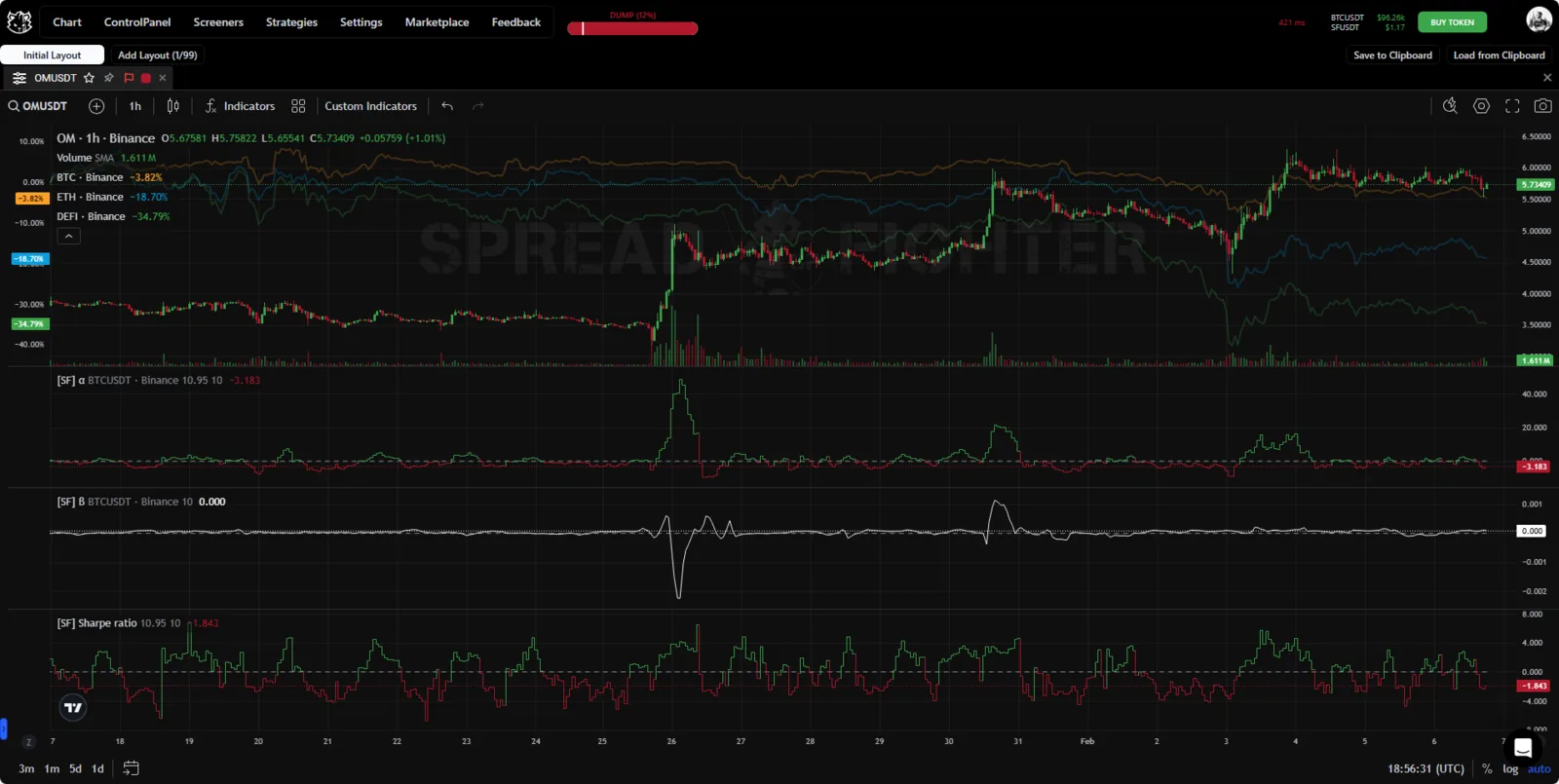
Indicator appearance.
Description
The alpha coefficient (α, alpha factor) is a measure calculated for a security's price. It links portfolio return to a benchmark return.
Alpha (α) is calculated by the following formula:
where is the asset's return, is the risk-free rate, is the benchmark return, and is beta.
The beta coefficient () shows the sensitivity of an individual asset's price to the index value.
For example, a beta of 2 means that if the index rises 1 percent, the security's price will rise 2 percent.
A negative beta shows an inverse relationship between the security's price change and the index value. A beta of zero shows no relationship between the security's price change and the index.
Beta () is calculated by the following formula:
The Sharpe ratio is a measure of the average return in excess of the risk-free rate, divided by one unit of volatility, or total risk.
The Sharpe ratio is calculated by the following formula:
where is the asset's return, is the risk-free rate, and is the asset's volatility.
Features
The indicators are oscillators. The user can set the required values for each argument of the model.
Use cases
Beta
TomoChain (TOMO) is the governance token and base asset of the TomoChain masternode-based blockchain network, which runs on a modified PoSV proof-of-stake algorithm.
Sources: block-chain24.com
GMT is the native token of STEPN, a move-to-earn project. STEPN is a Web3 app with built-in Game-Fi and Social-Fi elements. It is built around an important everyday activity for most people: moving around. It is the first project to bring a working move&earn concept to life, finishing 4th out of more than 500 projects at the Solana Ignition 2021 hackathon. Users equip themselves with NFT sneakers. By walking, jogging or running outdoors, users earn in-game currency that can be used in the game or cashed out for profit. With Game-Fi, STEPN aims to nudge millions of people toward a healthier lifestyle, fight climate change and bring the public to Web 3.0, while building on the Social-Fi side to create a lasting platform for Web 3.0 user-generated content.
Source: block-chain24.com
Consider a synthetic position: TOMO long against GMT short. Beta tends to zero. The lack of correlation between the equity of the agent's positions and the benchmark can be seen both quantitatively, with the Pearson linear correlation coefficient indicator, and visually (the semi-transparent gray chart in the background).
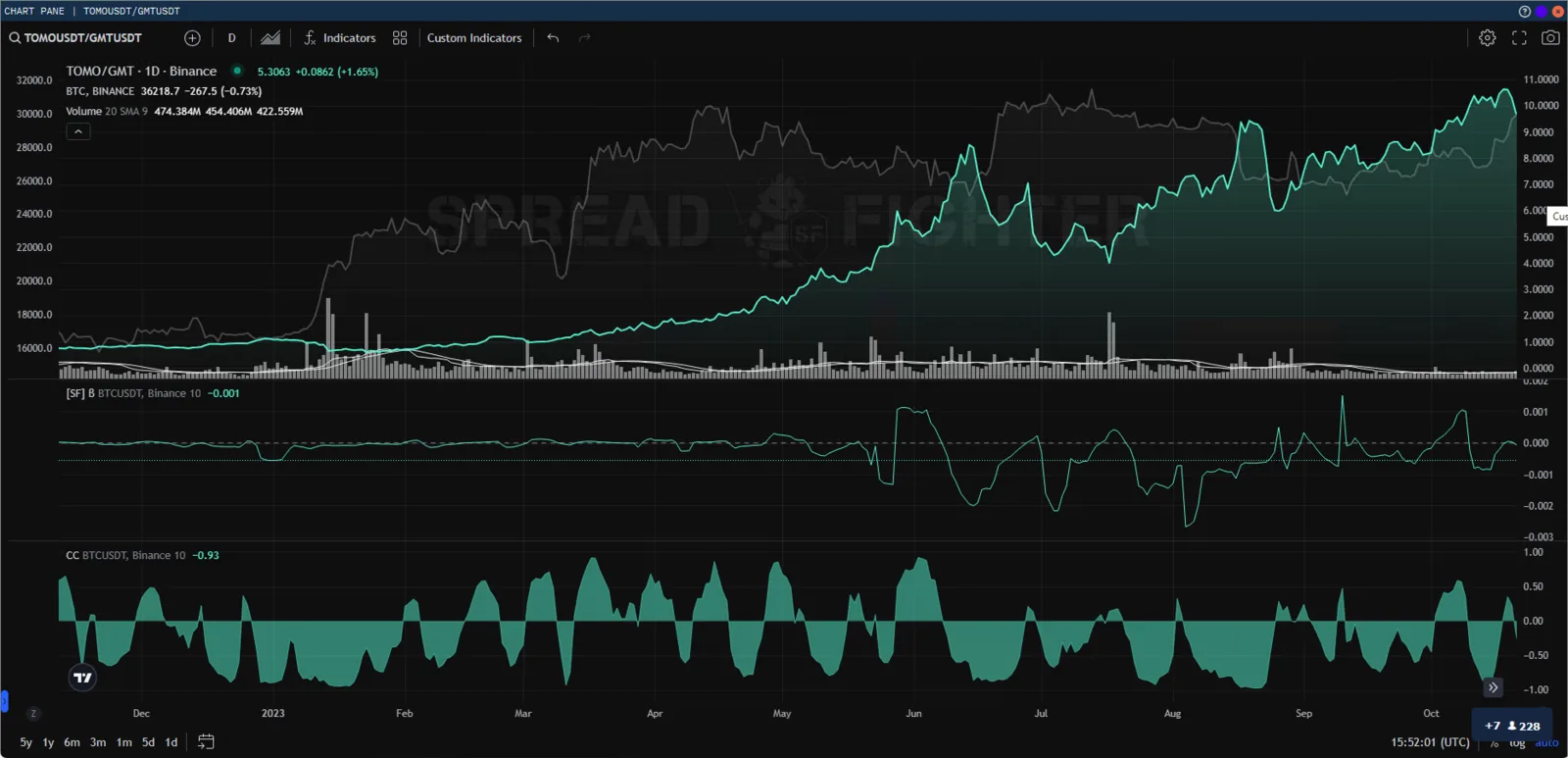
Synthetic TOMO/GMT position against BTC.
For a clearer demonstration, consider how beta behaves for a long position (left chart) and a short position (right chart) in the benchmark.
In the first case, beta and the correlation coefficient tend to one. This means the asset moves in perfect sync (which is logical, since the benchmark is measured against itself).
In the second case, beta and the correlation coefficient tend to minus one. This means the asset moves in exactly the opposite way: if the benchmark changes by 1%, the asset changes by -1%.
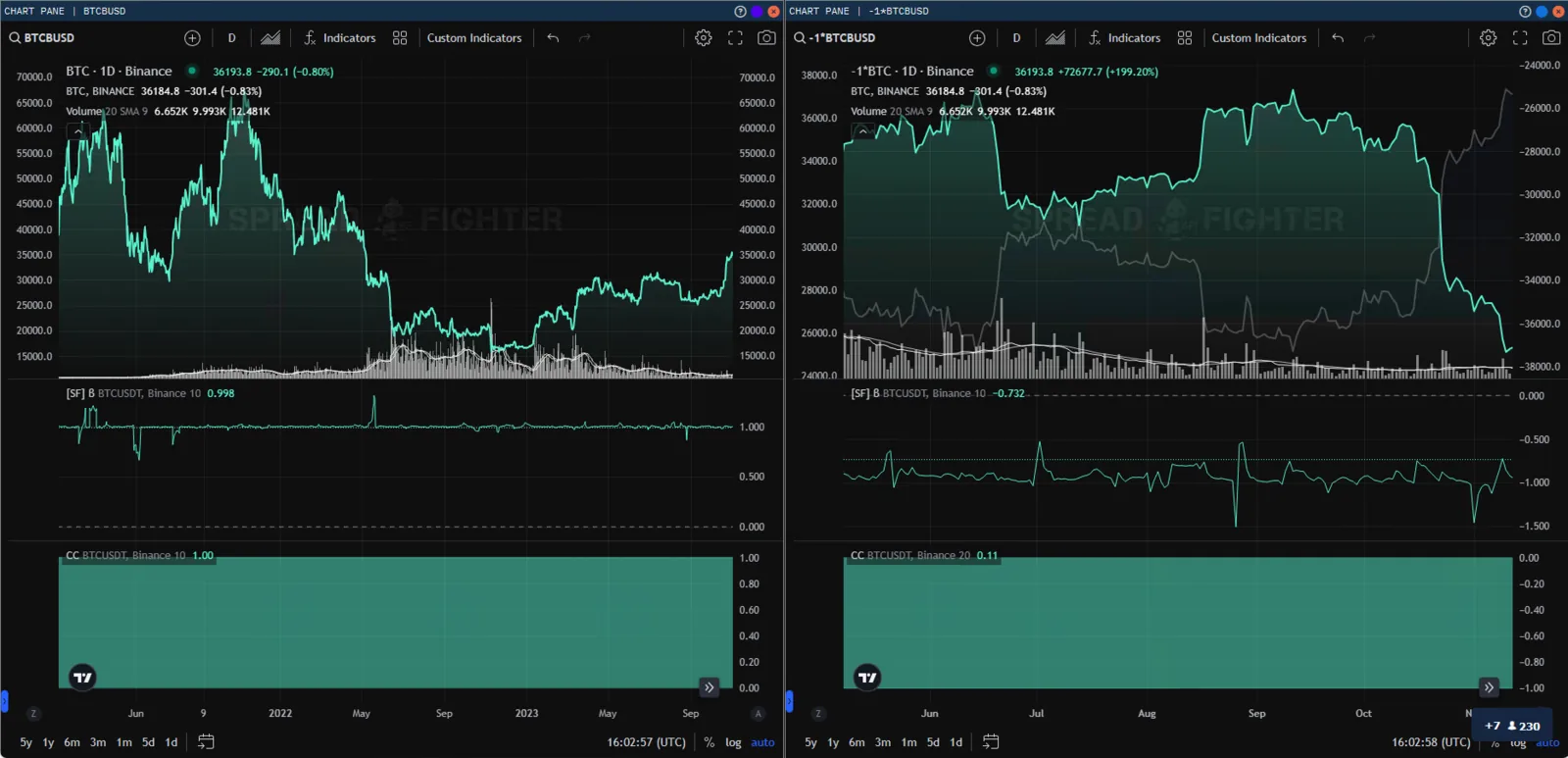
Long and short BTC positions against BTC.
Alpha & Sharpe ratio
Balancer is an automated market maker, a decentralized exchange (DEX) and a liquidity pool protocol built on Ethereum. It lets users provide liquidity for several assets at once. The Balancer token (BAL) acts as a governance token. It powers features such as issuance rewards and whitelisting of liquidity mining pools. When users trade, their orders are filled by several pools with better prices and a smaller spread.
Source: block-chain24.com
Avalanche is positioned by its developers as a highly scalable open-source platform for launching highly decentralized applications, built for new financial primitives and interoperable blockchain networks.
Source: block-chain24.com
The Balancer project was developed until March 2023, but developer activity then died down. Over 2023 the BAL token lost 50% of its value from that point, while the benchmark gained 130%.
Sharpe ratio and Alpha were -1.25 and -29.6 for the year, respectively. So holding a long position in BAL throughout 2023 was not justified in terms of potential risk and reward.
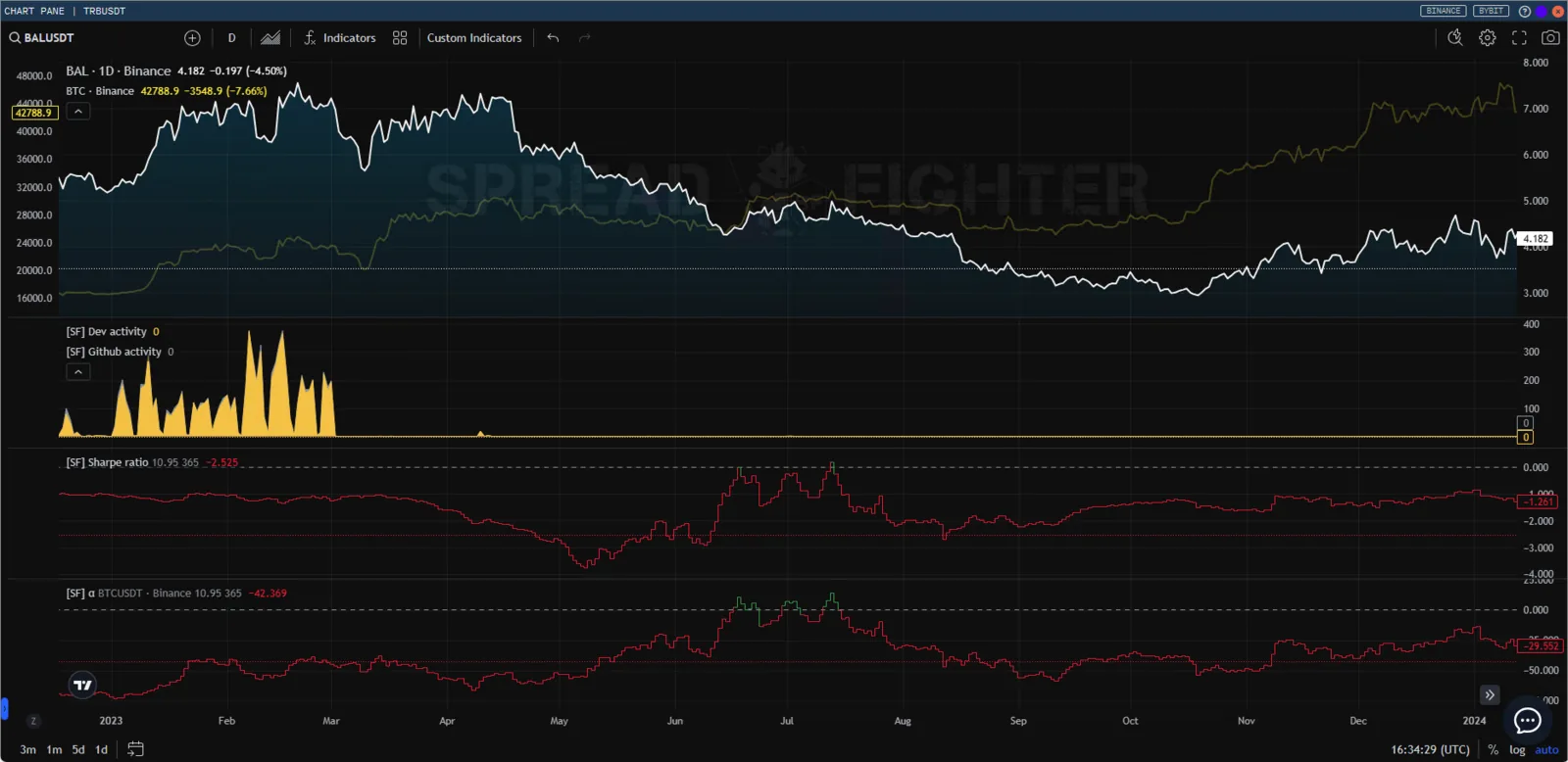
BAL Sharpe ratio & Alpha.
The Avalanche project showed high developer activity throughout the year.
Sharpe ratio and Alpha were 15.69 and -269.86, respectively. So holding a long position in AVAX throughout 2023 was justified in terms of potential risk and reward.
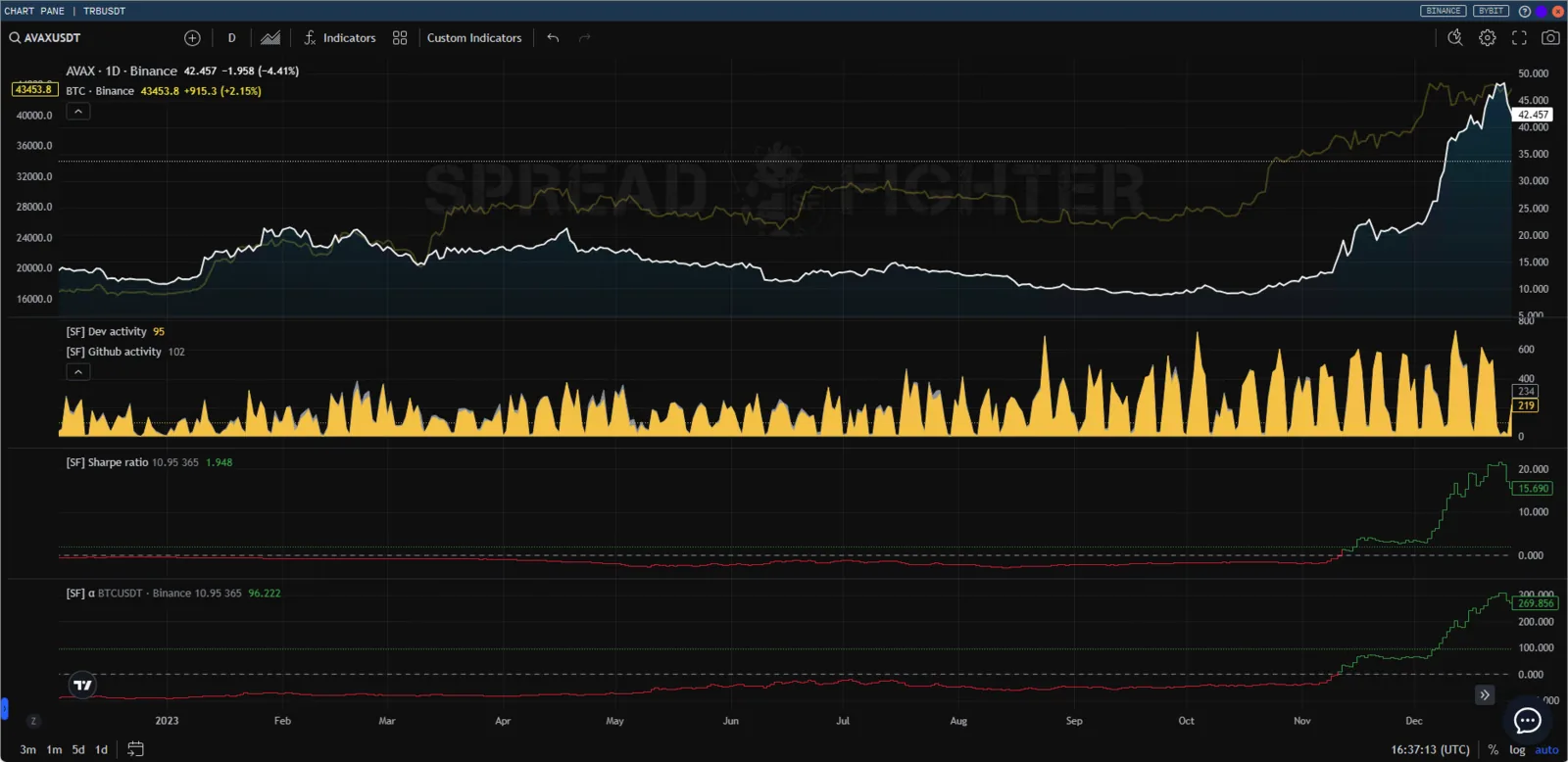
AVAX Sharpe ratio & Alpha.