Value at risk
The risk premium of a long position in an asset.
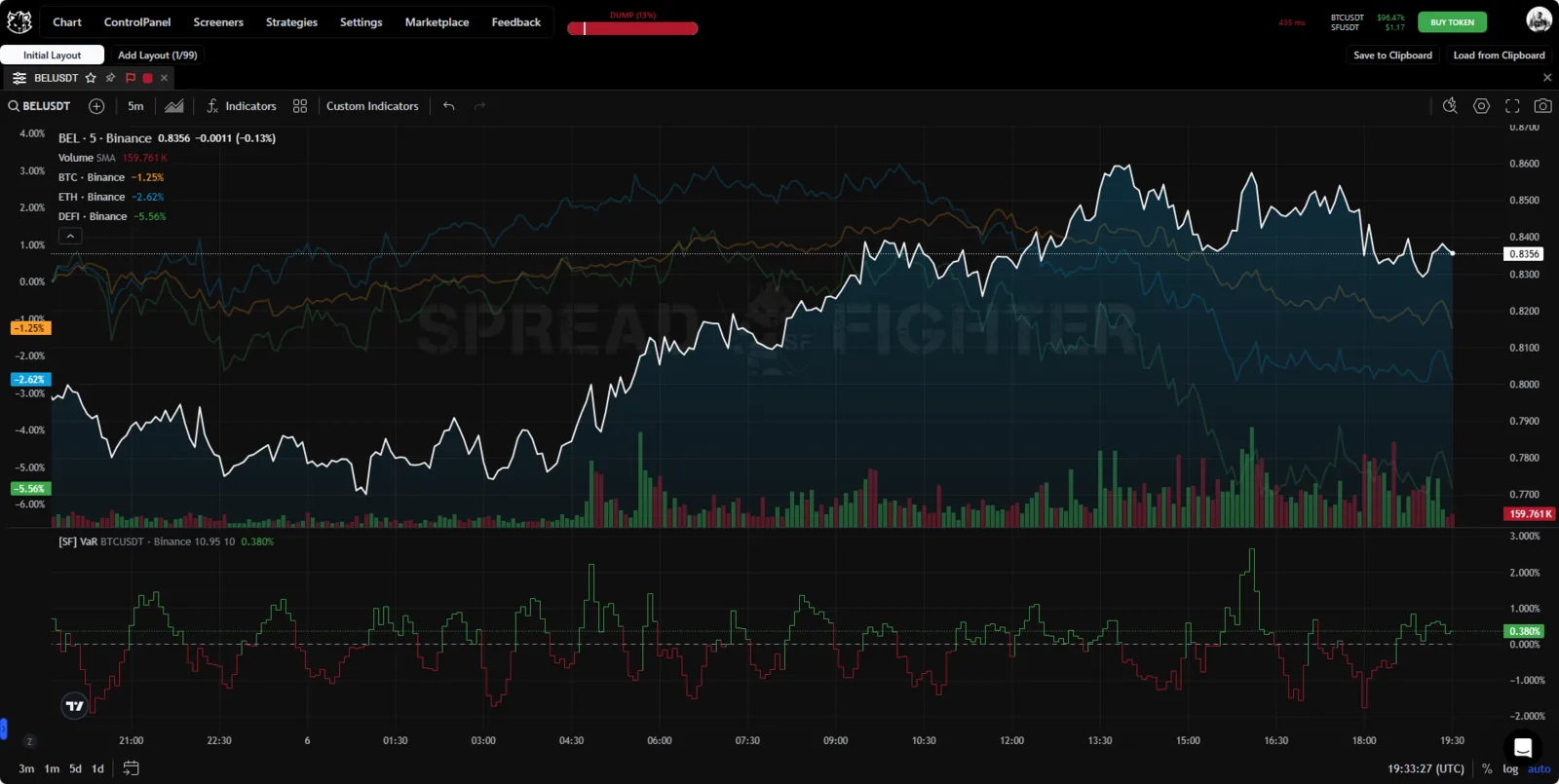
Indicator appearance.
Description
Value at risk (VaR) is calculated by the formula:
where is the return on investment from a long position in the asset under consideration over the period, (risk free return) is the risk-free rate, and (benchmark return) is the benchmark return.
By default, the risk-free rate is the return of the strategy that arbitrages benchmark funding rate payments, and the benchmark return is the return from holding a long BTC position.
The return on investment is calculated by the formula:
where is the asset price.
Understanding market and equity risk premiums
Investments carry different degrees of risk. For example, if an investor buys stocks, there is a risk that the stock price may fall, which opens the possibility that the investor will take a loss when selling the position.
As a result, compensation for taking on risk is required, and investments that carry more risk should offer an additional opportunity to earn a profit.
However, US Treasury bonds are usually considered risk-free income if the bond is held to maturity. In other words, because Treasury bonds are backed by the US government and have the highest AAA credit rating, their yield or interest rates are considered risk-free. As a result, Treasury bonds are usually used as a benchmark when calculating the risk-free rate that investors could earn if they invested in Treasury bonds.
In other words, investments should at least earn the risk-free rate; otherwise the risk is not justified.
In the classical view, the difference between the risk-free rate and the asset's return is the risk premium, or market risk premium.
Market risk premium
The market risk premium is the difference between the expected return of an investment portfolio and the risk-free rate. Because Treasury bonds are considered the risk-free rate, the market risk premium for a portfolio is the difference between the portfolio's return and the chosen Treasury bond yield.
There are different types of market risk premiums, depending on what the investor is trying to determine. Historical analysis can, for example, look at the difference between a portfolio's return over the last two years and the return on two-year Treasury bonds over that period. When comparing historical market risk premiums, the process is fairly simple. However, past portfolio results are not a predictor of future returns.
The expected or forecast market risk premium can vary by investor, because each has their own biases, risk tolerance levels and views on the market.
To illustrate, suppose a person has $10,000 to invest. They could put the money into Treasury bonds with a relatively low yield, say 2% per year. If they choose Treasury bonds, the chance of losing the principal is practically zero. Any return above 2% is the market risk premium that investors require to put their money into a portfolio or index.
However, the Treasury is not the only institution that needs their money. Private corporations offer bonds and stocks to raise capital or money. But they cannot offer the same safety as Treasury bonds. So corporations have to raise the yield offered on their instruments to compensate for the risks and to encourage the investor to put their money in.
Equity risk premium
The equity risk premium is the additional return from investing in stocks, above the risk-free rate. Like the market risk premium, equity risk premiums compensate investors for the additional risk of buying and selling stocks.
The size of the premium can vary with fluctuations in the stock price. The premium depends on the level of risk of the stock or group of stocks in question. High-risk stocks often have higher risk premiums.
Stock returns can fluctuate depending on general macroeconomic conditions in the global economy. If, for example, consumer spending in the US falls, stocks of companies that benefit from retailers are likely to carry a higher risk of financial loss, and so greater risks.
Equity risk premiums exist because investors demand a premium on the income from their stock investments compared with income from low-risk or risk-free investments such as Treasury bonds. In short, if an investor's money is exposed to a greater risk of loss, a higher premium will probably be needed to encourage them to buy.
Source: investopedia
Risk premium in the crypto market
As of 2023, the crypto market is fairly young and has no established models for estimating the expected returns of projects, so we use a somewhat different formula for the risk premium. As the risk-free rate, we take the return from arbitrage of funding rate payments, and we additionally account for the benchmark return.
The benchmark is the return from holding a long spot BTC position.
Trading any assets (not only crypto) is first of all an assessment of risks, risk premiums and the exchange of risks. So when managing a portfolio, it is extremely important for the agent to know the answers to the following questions:
- Does the agent pay for risk, or is the agent paid for risk?
- Does the agent pay enough, or is the agent paid enough, for the risk? And why?
- Does the expected return match the risk premium? How justified is the investment relative to the risk-free rate?
Let us look at the Value at risk model in practice using two assets: BLZ and BNB.
Bluzelle is a blockchain platform of distributed databases for decentralized applications that lets you manage data in a secure, censorship-resistant and well-scalable way. Bluzelle runs on the Cosmos SDK and its Tendermint BFT technology, which makes it compatible with various blockchains. As developers keep building Dapps, relying on centralized databases from AWS, Microsoft and other companies means having a centralized point of failure. True freedom requires decentralizing the whole stack, not just part of it. This is where Bluzelle aims to provide a critical role in the development of DeFi, supply chains, games and other Web 3.0 sectors.
As of 22 Nov 2023, the risk premium of the BLZ coin is strictly in the positive zone and equals ~15.4%. That is, on a weekly planning horizon, the agent pays 15.4% for risk relative to the benchmark.
A weekly horizon is used for the calculation.
Source: block-chain24.com
BNB is a cryptocurrency that powers the Binance Chain ecosystem. BNB is one of the most popular utility tokens in the world. You can not only trade BNB, like any other cryptocurrency, but also use BNB for a very wide range of additional benefits. Click here to learn more about BNB.
Source: binance
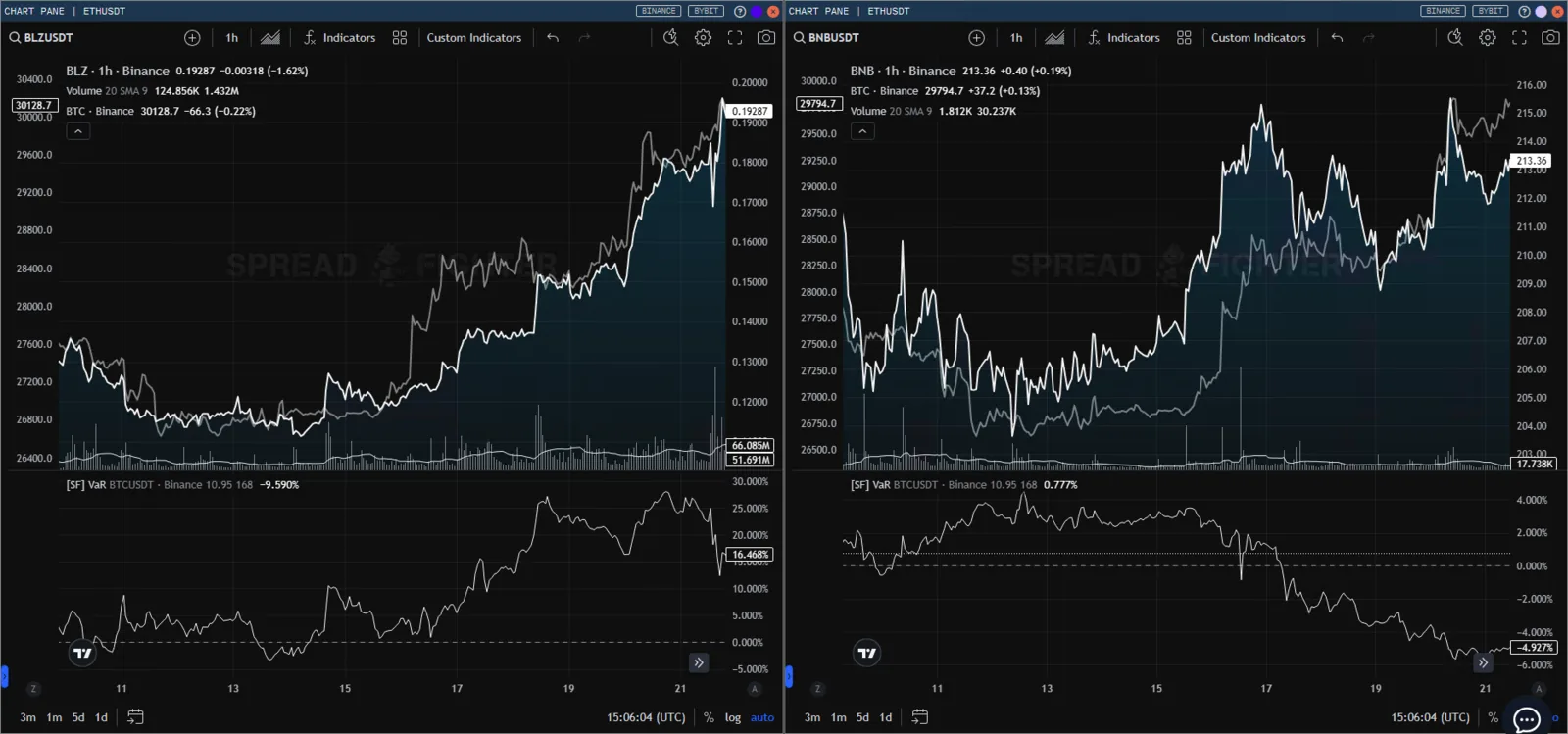
22 Nov 2023 BLZ & BNB - risk premium.
Let us look deeper at what could be behind such a divergence.
For several months before this article was written, BLZ has shown steady growth that outpaces the market narrative several times over. This may be due to increased user activity on social media, major updates, investments from large participants, or microstructure changes in the asset's quoting - in the context of this article it does not matter (we suggest you study the reasons yourself). What matters is that investors expect a return above the benchmark and are ready to pay extra for their expectations.
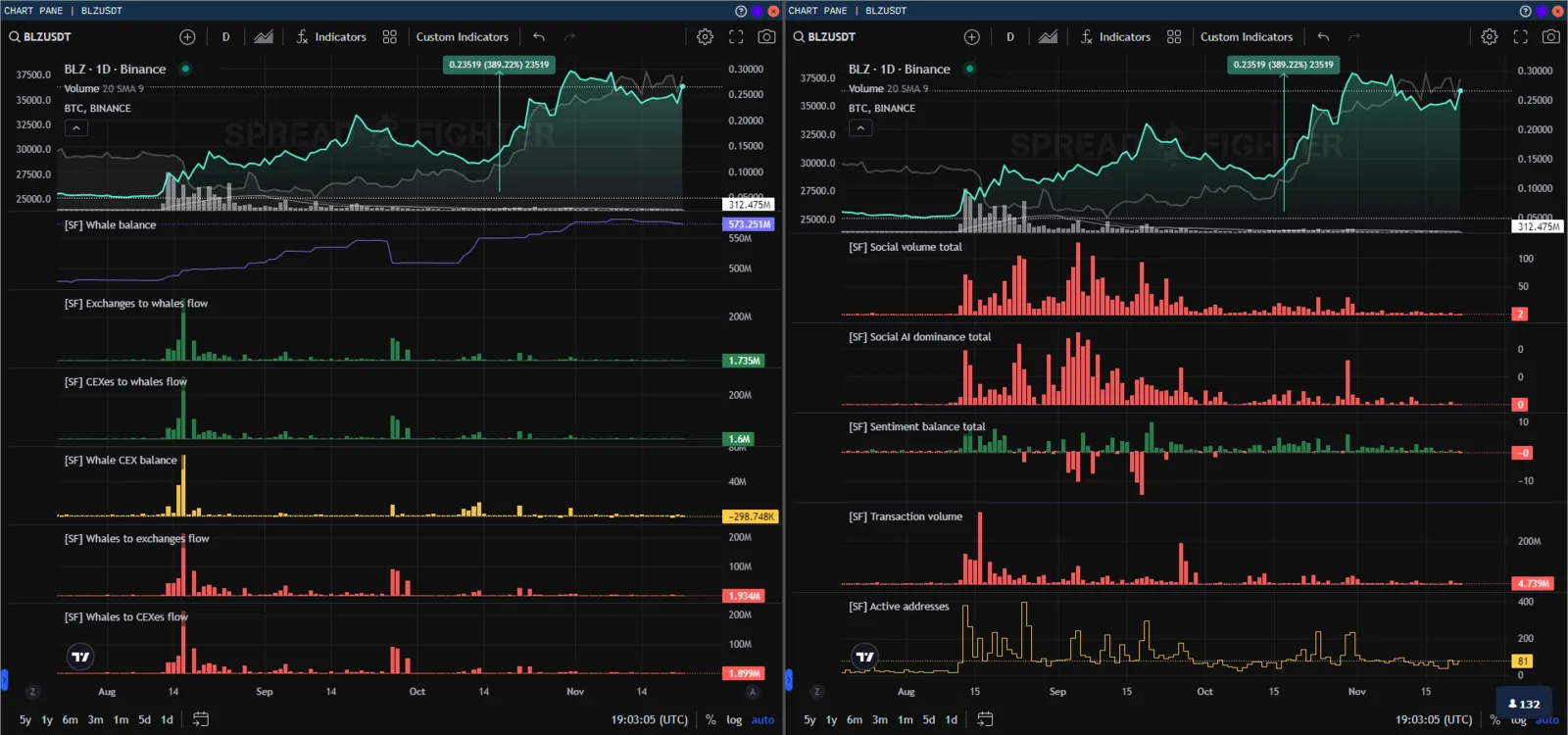
BLZ sentiment metrics.
If you follow the news agenda, you probably know what is behind the situation with BNB. On 21 Nov 2023, the crypto exchange Binance and the US Department of Justice reached a settlement, under which:
- Binance CEO Changpeng Zhao resigns and personally pays a fine of $50M;
- Binance will pay a fine of $4.3B.

Source: twitter
This news background undoubtedly puts the exchange's business, and accordingly its native BNB token, in a vulnerable position. So investors expect higher risks relative to the benchmark and are ready to take them only if they are paid extra for the risk.