SF - Market capitalization
The total capitalization of a project
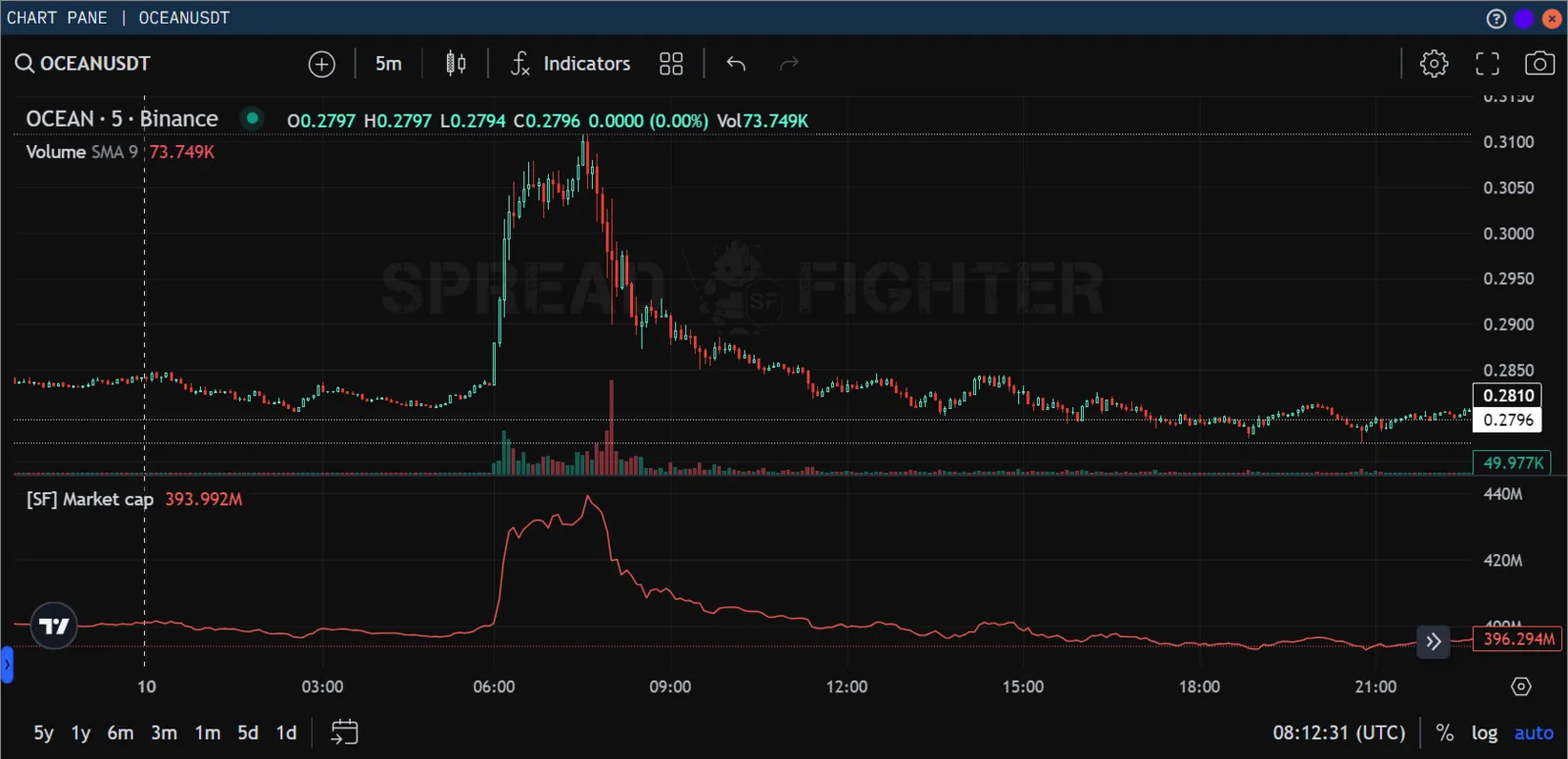
Indicator appearance
Description
Market capitalization is a sentiment analysis indicator that shows the total capitalization of a project in dollars.
Market capitalization is calculated by multiplying the current price of the asset by its total supply.
Functionality
In the chart settings window, the user can choose the display colors and the transparency of the indicator.
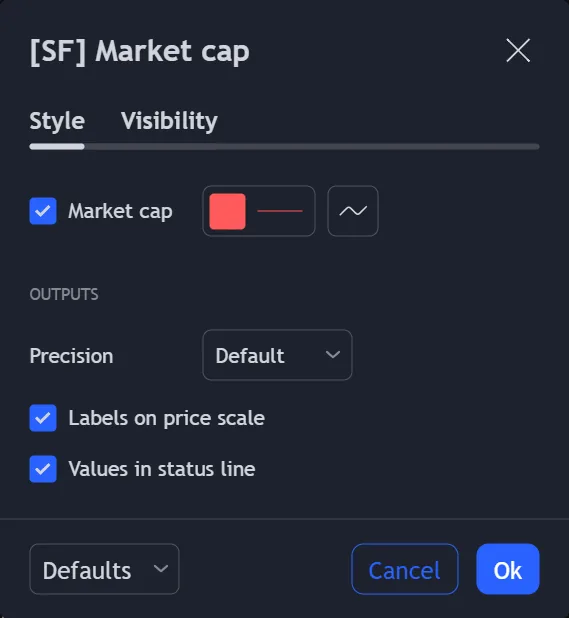
Indicator chart settings
Access by plan
The indicator is available on all subscription versions.
What market capitalization is
Market capitalization is the total dollar market value of a project's tokens or a company's shares in circulation. The investment community uses this figure to determine the size of a project instead of sales figures or total assets. In an acquisition, market capitalization is used to determine whether a takeover candidate is good value for the buyer or not.
Understanding market capitalization
Understanding the value of a company or project is an important task that is often hard to do quickly and accurately. Market capitalization is a fast and simple method of estimating the value of a company or project by extrapolating the market's opinion.
Once a company or project goes public and starts trading on an exchange, its price is set by the supply and demand for its shares in the market. If favorable factors create high demand for its shares, the price rises. If the company's future growth potential does not look good, share sellers may lower the price. Market capitalization then becomes a real-time estimate of the company's value.
Important: the share price of one company can be 50 dollars. The share price of another company can be 100 dollars. This does not mean the second company is twice as large as the first. When analyzing securities, always remember to take the number of issued shares into account (and so analyze the company's total market capitalization).
How to calculate market capitalization
The formula for market capitalization:
where is the asset supply, is the current price of one unit of the asset.
Let us calculate BTC capitalization as of 15 Nov 2023. The supply is 21000000 tokens, the current price is $ 37372.89. So BTC capitalization is 21000000 * $ 37372.89 = $ 784,830,690,000, which is approximately the figure shown on popular services that publish information about crypto projects.
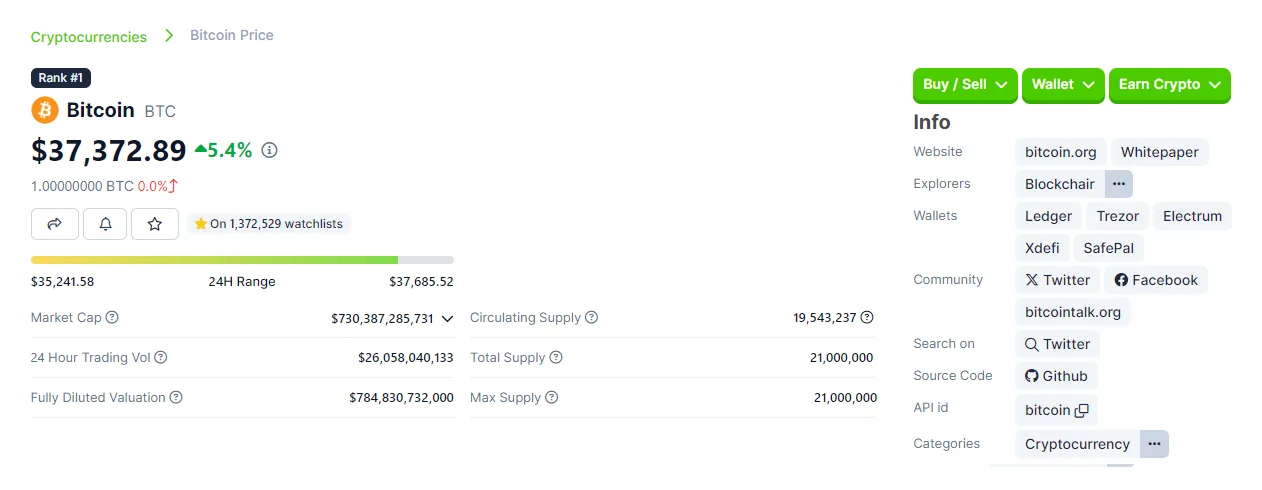
Bitcoin page on coingecko
Depending on the source, the information can differ because of different inputs, frequency and method of recalculation (more on this below). But the order of magnitude is the same.
https://www.coingecko.com/en/coins/bitcoin
Market capitalization and investment strategy
Given how simple and effective it is for assessing risk, market capitalization can be a useful metric for deciding which assets interest an investor, and for diversifying a portfolio across companies of different sizes.
Companies and projects with large capitalization (also known as "large caps") usually have a market capitalization of 10 billion dollars or more for the US stock market and 1 billion dollars in the crypto market. These companies have usually existed for a long time and are major players in established industries. Investing in large caps does not necessarily bring huge profit in a short time, but in the long run these companies usually reward investors with a steady rise in asset value and dividend payments. Examples of large-cap companies (keep in mind that this is a constantly changing sample) are Apple Inc., Microsoft Corp. and Google's parent company Alphabet Inc.
Companies and projects with medium capitalization usually have a market capitalization of 2 to 10 billion dollars for the US stock market and 200 million to 1 billion dollars for the crypto market. Mid-cap companies are established companies that work in an industry expected to see fast growth. Mid-cap companies are in the process of expanding. They carry inherently higher risk than large-cap companies, because they are less well established, but they are attractive for their growth potential. One example of a mid-cap company is Eagle Materials Inc. ( EXP ).
Companies with a market capitalization of 300 million to 2 billion dollars for the US stock market and up to 200 million dollars for the crypto market are usually classified as small-cap companies. These small companies may be younger and/or may serve niche markets and new industries. They are considered higher-risk investments because of their age, the markets they serve and their size. Small companies with fewer resources are more sensitive to economic downturns.
As a result, the share prices of small-cap companies tend to be more volatile and less liquid than the share prices of more mature and larger companies. At the same time, small companies often offer more growth opportunities than large-cap companies. Even smaller companies are known as micro-cap companies, with a value of roughly 50 to 300 million dollars.
The data is current as of the time of writing: 15 Nov 2023
Diluted market capitalization
The market capitalization of a security can change over time because of the number of shares in circulation. This is especially common in crypto, where new tokens or coins are often issued or minted.
Since new issuance in theory reduces the value of existing coins, tokens or shares, you can use another market capitalization formula to calculate the potential market capitalization if all allowed shares or tokens are issued and still trade at the current price. This concept is called diluted market capitalization, and the formula is:
Diluted market capitalization = current share price * total number of allowed shares.
For example, consider bitcoin trading at about 24,000 dollars per coin as of mid-August 2022. However, the total number of potential bitcoins that can eventually be mined is 21 million. So the calculations of Bitcoin's market capitalization are:
Market capitalization = 24,000 USD * 19.1 million dollars = 458.4 billion USD.
Diluted market capitalization = 24,000 USD * 21 million = 504 billion USD.
Analysts use diluted market capitalization to better understand potential changes in the price of a security, token or coin. For example, imagine that all 21 million bitcoins are minted tomorrow. If the company kept the same market capitalization of 458.4 billion dollars, the price would have to fall to about 21,828 dollars (458.4 billion dollars / 21 million dollars). So companies with large stocks of unissued securities or coins face a higher risk of a price fall if investors want to keep their market capitalization unchanged regardless of the number of tokens in circulation.
Misconceptions about market capitalization
Although market capitalization is often used to describe a company, it is not a measure of the value of the company's equity. Only a careful analysis of the company's fundamentals can do that. It is not enough to value a company, because the market price it is based on does not necessarily reflect the value of any part of the business. Shares are often overvalued or undervalued by the market, which means the market price only determines how much the market is ready to pay for its shares.
Although market capitalization measures the cost of buying all of a company's shares, it does not determine the amount the company would cost in a merger deal. A better method for calculating the price of acquiring a business is enterprise value.
Changes in market capitalization
Two main factors can change a company's market capitalization: significant changes in the share price, or the company issuing or buying back shares. An investor who uses a large number of warrants can also increase the number of shares on the market and hurt shareholders in a process known as dilution .
Is it better to have a large market capitalization?
Having a large market capitalization has its pros and cons. On the one hand, larger companies can get better financing terms from banks and by selling corporate bonds. These companies can also benefit from competitive advantages tied to their size, such as economies of scale or wide brand recognition.
On the other hand, large companies may have limited room for further growth, so their growth rates may slow down over time.
Does market capitalization affect the share price?
Market capitalization does not affect the share price. Rather, market capitalization is calculated by analyzing the share price and the number of issued shares. Although "blue chip" stocks may show higher results thanks to organizational efficiency and a larger market presence, simply having a higher market capitalization has no direct effect on share prices.
You could argue that analysts track market capitalization to determine which companies may be undervalued or overvalued. From this point of view, market capitalization can push an investor to buy or sell shares depending on the company's relative value compared with its industry or competitors. Still, the share price is defined as the fair value set by the market, not by the company's market capitalization.
How important is market capitalization?
Market capitalization shows the size of a company. It is an important analytics tool, especially when comparing companies. Market capitalization is often used as a basis for analysis, because all other financial metrics must be viewed through this lens. For example, a company might have twice the revenue of any other company in the industry. However, if the company's market capitalization is four times larger, you could argue that the company is inefficient.
Key takeaways
Market capitalization can be a valuable tool for an investor who follows stocks and evaluates potential investments. Market capitalization is a fast and simple method of estimating the value of a company by extrapolating what the market thinks a publicly traded company is worth. The investment community uses this figure to determine the size of a company, instead of using sales figures or total assets. In an acquisition, market capitalization is used to determine whether a takeover candidate is good value for the buyer or not.
Key takeaways
- Market capitalization shows how much a project is worth according to the market. It is defined as the total market value of all tokens or shares in circulation.
- To calculate market capitalization, multiply the number of assets in circulation by the current market value of one asset.
- Market capitalization is often used to determine the size of a company, and then to evaluate the company's financial metrics against other companies of different sizes.
- In investing, companies with a higher market capitalization are often safer investments, because they are more established companies with a longer business history.
Source: investopedia